
Cloud Hosting vs VPS: Which One Should You Choose?
Cloud hosting vs VPS comes down to one question: where does your website run? A VPS is a fixed slice of one physical server, with a set amount of CPU and RAM at a fixed monthly price. Cloud hosting runs your website across a cluster of connected servers, so it can add resources quickly and keep running if one machine fails, but the bill can change with usage. Choose a VPS for steady traffic and a predictable budget; choose cloud hosting when traffic jumps around or downtime is very expensive for you.
How a VPS works
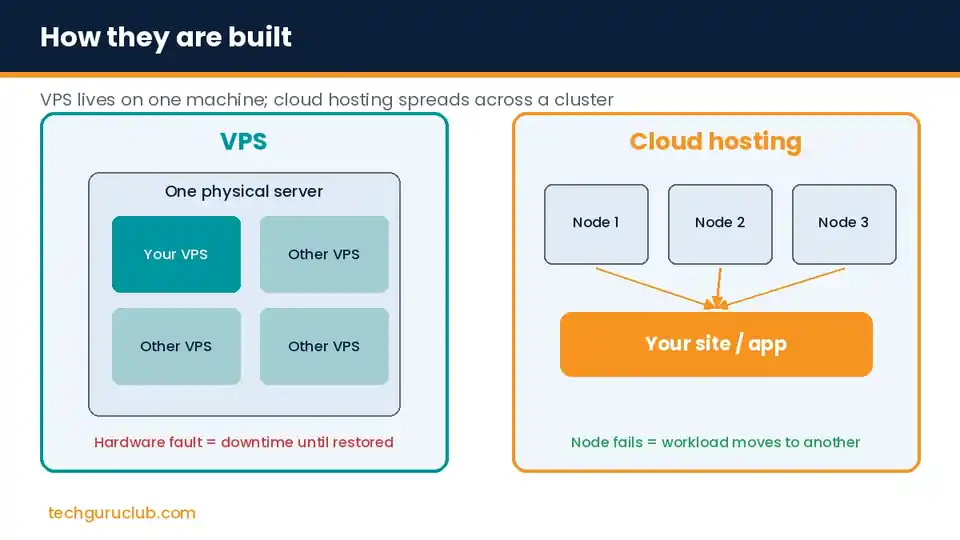
A virtual private server is created by splitting one physical server into several isolated virtual machines. Your VPS gets its own share of CPU, RAM and storage, its own IP address and full root access. It behaves like your own server, but it still lives on one physical machine. We explain this in more detail in what is VPS hosting.
How cloud hosting works
Cloud hosting pools many servers together. Your website or app runs on resources drawn from that pool, and storage is usually kept on a separate, replicated storage system. If one server in the cluster has a hardware fault, your workload moves to another one. Resources can be added in minutes, and on some platforms they scale up and down automatically.
“Cloud hosting” is used for two quite different products, so check which one you are buying:
- Managed cloud hosting: a control panel plan, similar to shared hosting, running on cloud infrastructure. You get a panel, not root access.
- Cloud servers (IaaS): virtual machines on platforms such as AWS, Azure or Google Cloud, billed by the hour or by usage, with full root access.
Cloud hosting vs VPS: side by side
Performance
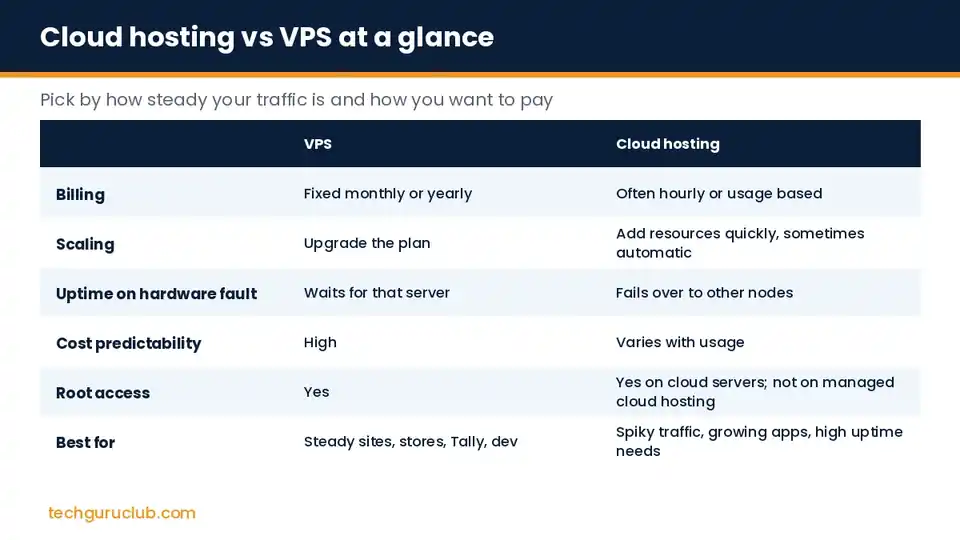
For the same CPU and RAM, a good VPS and a good cloud server perform about the same. The real differences are storage speed (local NVMe on a VPS can be faster than network storage) and how quickly you can add more resources when traffic rises.
Uptime
Cloud hosting handles hardware failures better because the cluster can restart your site on another node. A VPS waits until its physical server is repaired or restored from backup. Snapshots and offsite backups reduce that risk, but they do not remove it.
Scaling
A VPS scales by upgrading to a bigger plan, which may need a reboot. Cloud platforms let you add CPU, RAM or extra servers in minutes, and some do it automatically when traffic spikes.
Cost
A VPS has a fixed price, so your monthly bill is the same whether your traffic is high or low. Cloud servers billed by usage can cost less when traffic is low and much more during a busy month. Bandwidth, storage and backups are often charged separately, so always estimate a full month before you choose.
Control
Both a VPS and a cloud server give you root access. Managed cloud hosting plans do not, but they handle server updates and security for you.
Which one should you choose?
| Your situation | Better fit |
|---|---|
| Business website with steady traffic | VPS, or managed cloud hosting if you want no server work |
| WooCommerce store with regular sales | VPS with NVMe and daily backups |
| Store or app with big seasonal spikes | Cloud servers that can scale for the peak |
| Tally or office apps for a team | Windows VPS |
| SaaS product or app where every minute of downtime costs money | Cloud servers across more than one node |
| Small site, no technical staff | Managed cloud hosting with a control panel |
Questions to ask before you buy
- Is this a fixed-price plan or usage-based billing? What does a busy month cost?
- Is storage local NVMe or network storage?
- What happens if the physical server fails, and how long until I am back online?
- Are backups and snapshots included, and where are they stored?
- Is there a data centre in India?
- Do I get root access, a control panel, or both?
Frequently asked questions
Is cloud hosting faster than a VPS?
Not by default. Speed depends on CPU, RAM, storage type and location. Cloud hosting is better at staying online and growing quickly, not automatically faster.
Is a VPS cheaper than cloud hosting?
For steady workloads, usually yes, because you pay a fixed price. For sites that are quiet most of the month and busy for a few days, usage-based cloud billing can work out cheaper.
Can I move from a VPS to the cloud later?
Yes. Websites and most apps can be moved by copying files and databases to the new server and changing DNS records.
Is “cloud VPS” the same as cloud hosting?
Not always. Many providers call a normal VPS a “cloud VPS”. Ask whether it can fail over to another server if the hardware fails; if not, it behaves like a VPS.
Talk to us before you decide
Tech Guru Club offers VPS hosting with fixed INR pricing, NVMe storage and snapshots, and Premium Cloud Linux Hosting with a ready control panel and free SSL. Share your traffic and budget and we will recommend the right fit.
Related reading: Best VPS hosting in India, Linux VPS hosting, what is VPS hosting and best web hosting for small business in India.


